The collegiate church of Saint-Ours
A Romanesque church remodelled in the Gothic style, and its cloister with carved capitals

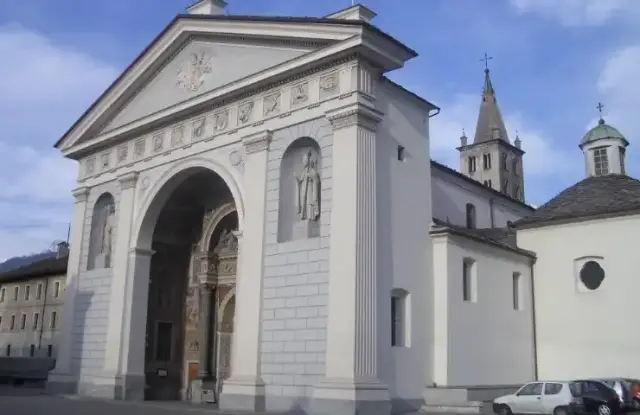
The collegiate church of Saints Peter and Ours stands to the east of the old town of Aosta, at 10 rue Saint-Ours. Together with the cathedral, it is the most important group of buildings for understanding the religious art of the Aosta Valley: a church, a bell tower, a cloister and a priory, built over more than a thousand years.
At the beginning of the 11th century
The present church was begun under Bishop Anselm I, between 994 and 1025. It was originally dedicated to St Peter. It was built on the remains of an early Christian basilica and a Carolingian church. The church has a nave and two aisles. Today it combines the Romanesque and Gothic styles.
From Romanesque to Gothic
The building was altered several times. At the end of the 15th century and the beginning of the 16th, under Prior Georges de Challant, the church was given the Gothic appearance it still has. The priory, in the Renaissance style with its octagonal tower, was also built at this time.
A free-standing bell tower
The great bell tower does not touch the church. Its base dates from the 12th century. It is made of large blocks of stone, probably taken from Roman monuments. The upper part is thought to have been completed in the 13th century.
Inside the church
- Fragments of 11th-century frescoes. They are among the oldest Romanesque paintings in the valley.
- A 12th-century mosaic in the choir. It shows Samson slaying the lion, surrounded by a magic square, an inscription whose letters can be read in every direction.
- Carved wooden choir stalls dated 1487. They depict saints, prophets and fantastic animals.
- A treasury, with liturgical vestments, missals and objects of sacred art.

The Romanesque cloister
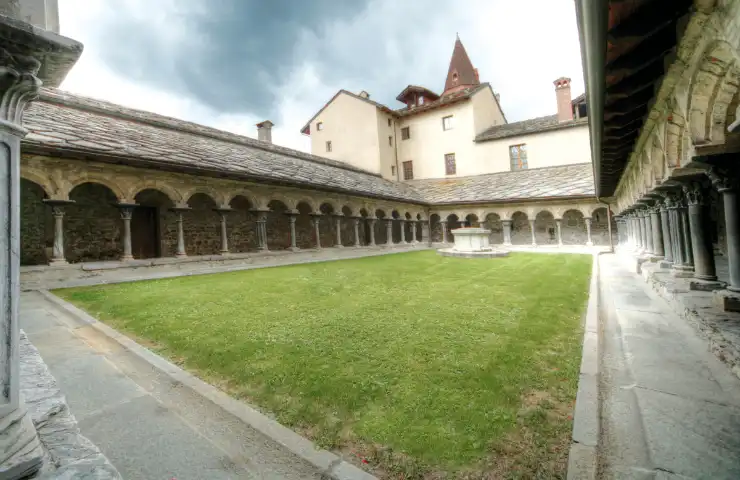
The cloister is the best-known part of the complex. An inscription dates its construction to after 1132. At that time, the religious community of Saint-Ours was reorganising itself under a new rule.
Its capitals are of white marble. They rest on columns of dark marble from Aymavilles. Each one tells a story: episodes from the Old Testament, the life of Jesus, fables like those of Aesop, and even events from local history.
Beneath the church, the excavations
Beneath the church, archaeologists found the remains of a 5th-century early Christian basilica. Bishops’ tombs were discovered there. According to tradition, St Grat, patron saint of the Aosta Valley, was buried on this spot.
Church and cloister of Saint-Ours
Piazzetta Sant’Orso
11100 AOSTA
(+39) 329 5444625
mirabiliaosta@gmail.com