Fort Bard
A 19th-century Savoyard fortress, built on the rock that had held up Bonaparte

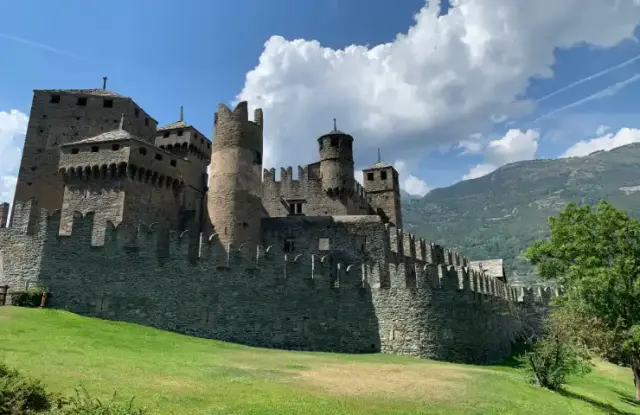
At Bard the valley suddenly narrows. A large rock almost blocks the way, just above the village and the Dora. Anyone who wanted to enter the Aosta Valley from below, or leave it for the plain, passed at its foot. Fort Bard occupies the top of this rock.
A barrier since the early Middle Ages
The site has been fortified for a very long time. The first fortifications are dated to the 6th century. The defences were then rebuilt and strengthened many times, using the techniques of each period and according to the powers that controlled the valley.
May 1800: Bonaparte held up
In May 1800, Bonaparte’s army crossed the Great St Bernard pass and marched down the valley towards the Po plain. At Bard it ran up against the fortress and its small Austrian garrison. The fort held out for about two weeks. The delay seriously hampered the French advance. Once the fort had been taken, Bonaparte had it razed.
Rebuilding from 1830 to 1838
The House of Savoy then decided to close this passage once again. The present fort was built between 1830 and 1838, to plans by the engineer Francesco Antonio Olivero. So it has little in common with a medieval castle: it is a 19th-century fortress.
Hauling the materials up such a steep rock was a major undertaking that required a large workforce.
Three tiers of buildings
The fortress consists of three main blocks, stepped up the slope: the Ferdinand work at the bottom, the Victor work in the middle and the Charles Albert work at the top. The engineers applied the defensive ideas of their day:
- thick walls of dressed stone;
- vaulted casemates, the covered chambers that sheltered guns and soldiers, designed to withstand bombs;
- a network of ramps and stairs linking the different levels.
The Museum of the Alps
In the 20th century the fort lost its military role. After a lengthy restoration, it opened to the public in 2006. Today it houses the Museum of the Alps and hosts temporary exhibitions. It is one of the most visited sites in the valley.