The Aiguille Blanche
The most remote summit of Mont Blanc

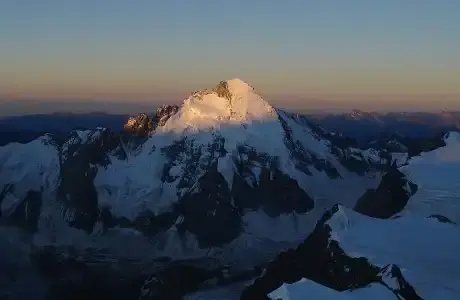
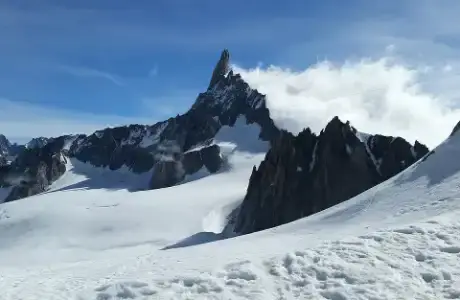
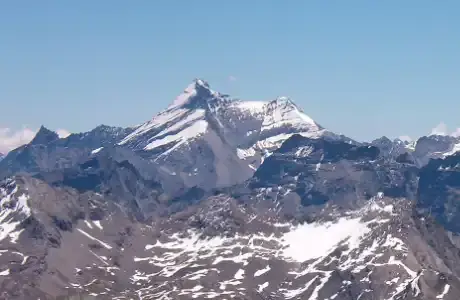
The Aiguille Blanche de Peuterey stands on the Italian side of Mont Blanc, above Val Veny and Courmayeur. It rises to 4,112 metres. No path and no cable car come near it: it can only be reached after a long high-mountain climb. Many mountaineers consider it the hardest 4,000-metre peak in the Alps to get to.
Three summits
The top forms a snowy ridge carrying three points of almost the same height. The highest bears the name of Güssfeldt, a German mountaineer. The other two recall two Britons, Seymour King and Jones. On either side, the slopes drop onto steep, crevassed glaciers, the Fresnay and the Frêney.
Halfway along the Peuterey ridge
The Aiguille Blanche is the pivot of the Peuterey ridge. This long crest starts in Val Veny, passes over the Aiguille Noire, then the Aiguille Blanche, and climbs to the summit of Mont Blanc. Between the Aiguille Blanche and the Mont Blanc de Courmayeur lies the Col de Peuterey, a snowy gap where roped parties often stop to bivouac. It is not easy to get back down from there: once committed, the simplest option is often to carry on upwards.
The first ascent, in 1885
On 31 July 1885 the Englishman Henry Seymour King reached the summit with three guides: Ambros Supersaxo, Aloys Anthamatten and Émile Rey. Rey was a Courmayeur guide, well known throughout the Alps in his day. He opened several routes on the Italian side of Mont Blanc. A few years earlier he had already made the first ascent of the Aiguille Noire.
Who is it for?
The climb is only for experienced mountaineers, at ease on ice as well as rock. The approach routes are long and exposed to rockfall and falling seracs. Bad weather is especially dangerous there, because it is hard to turn back. You often have to spend one or two nights in unstaffed bivouac huts. With the retreat of the glaciers, some sections have become more unstable in recent years.
Seeing it from Val Veny
To look at it, simply head up Val Veny from Courmayeur, towards the hamlet of Peuterey and the chapel of Notre-Dame de la Guérison. The Aiguille Blanche then appears behind the Aiguille Noire, higher and covered in snow. One glance tells you where its name (“white needle”) comes from.