The Grivola
The perfect point of the Gran Paradiso massif

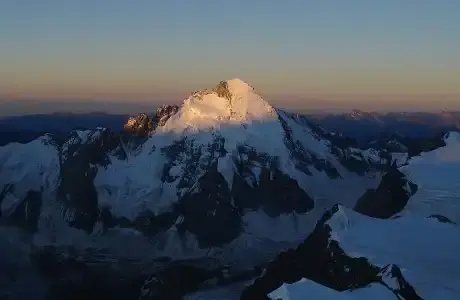
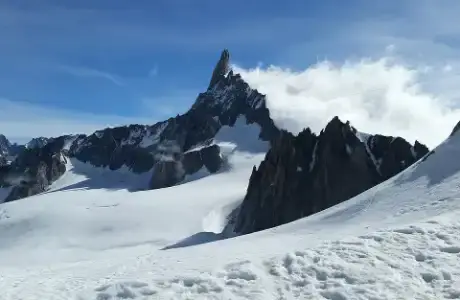
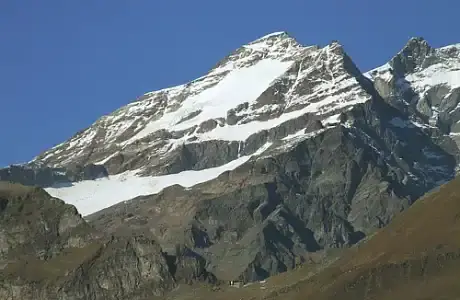
Seen from the main valley road, between Aosta and Villeneuve, the Grivola looks like a child’s drawing: a clean, white, perfectly regular point. It reaches 3,969 metres, just below the 4,000-metre mark. It is the second-highest summit in the Gran Paradiso massif. It rises between the Cogne valley to the east and the Valsavarenche to the west.
Many names for one mountain
Old documents give it several names: Pic de Cogne, Grivolet, Bec de Grivola, Aiguille de Grivola. The origin of the present name is uncertain. One theory links it to a patois word, ‘griva’, meaning thrush. But no explanation is certain.
Hanging glaciers
The summit is surrounded by glaciers. To the north, the Nomenon glacier descends towards the side valley of the same name, above Aymavilles. To the east, the Trajo glacier looks out over the Cogne valley. Around the main summit stand smaller peaks: the Pointe Blanche and Pointe Noire de la Grivola, and the Grivoletta. These glaciers have shrunk a great deal over the past few decades, and some have broken up into separate patches.
The first ascent, in 1859
On 23 August 1859 John Ormsby and R. Bruce reached the summit with three guides: Ambroise Dayné, Zacharie Cachat and Jean Tairraz. Cachat and Tairraz were guides from Chamonix. The Grivola was thus climbed a year before Gran Paradiso, even though the latter is higher.
In the national park
The whole mountain lies within the Gran Paradiso National Park. Ibex and chamois live on its slopes and can often be seen from the paths of the Cogne valley. The park rangers keep watch over these slopes from their observation posts in the side valleys.
A route for seasoned climbers
No easy route leads to the Grivola. The normal route usually starts from the Valsavarenche. It climbs a rock ridge that is often loose, then slopes of snow or ice depending on the season. The ascent, the descent and the walk back to the valley make for a very long day. Rockfall is a real danger in summer.
Looking at it from Cogne
The village of Cogne offers another fine viewpoint. From the great meadow of Saint-Ours, you can see it standing out to the west, above the larch forests. In winter, when the valley lies in shadow, its point stays lit by the sun for a long time.