The Aosta Valley cattle breeds
Red pied, black pied and chestnut: three coats for one mountain breed
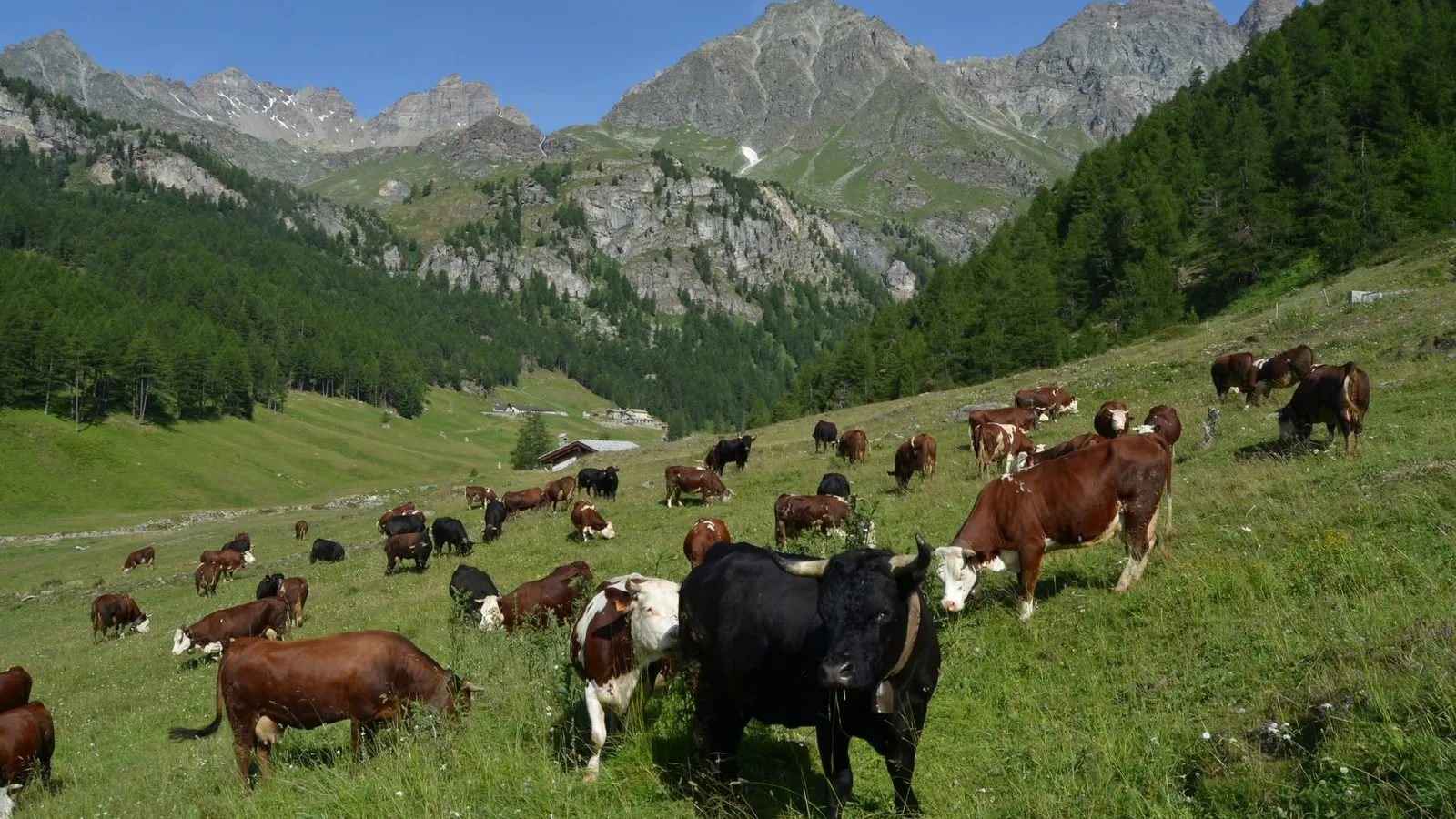
In the meadows and high pastures of the Aosta Valley, most of the cows you see belong to the Aosta breed. It comes in three different coats: red pied, black pied and chestnut. All are recorded in the same herd book, kept by A.N.A.Bo.Ra.Va.
The red pied
It is the most widespread breed in the western Alps, at the foot of Mont Blanc. Its coat is spotted with red, from light to dark, with a white head, belly, lower legs and tail. It is thought to descend from spotted cattle from northern Europe, brought by the Burgundians towards the end of the 5th century.
The black pied and the chestnut
These two varieties belong to the oldest group of Alpine cows, together with the Hérens breed of the Valais. They have a broad skull and a lively temperament.
- The black pied has a coat clearly divided between black and white. Its ancestry is purely from the Aosta Valley.
- The chestnut combines black and red, from almost black to fawn. It has Hérens blood.
Proud and spirited, these are the cows that compete, from spring to autumn, in the battles of the queens, held for more than fifty years.
Cows made for the mountains
All three varieties share the same qualities: sturdy legs and hard hooves, a fairly light build, good resistance to cold and disease, and the ability to live on rough forage. Every cow goes up to the high pastures in summer, sometimes as high as 2,500 metres. Farms are mostly family-run, with around fifteen cows on average. Nearly all calving takes place between November and March.
Milk and meat
The Aosta breed is dual-purpose: it gives both milk and meat.
- Its milk is very well suited to cheesemaking. Summer milk is made into Fontina PDO and Fromadzo PDO directly in the high pastures.
- In 2025 a red pied cow produced on average 3,915 kg of milk per lactation, and a black pied or chestnut cow 2,699 kg. That is little compared with lowland breeds, but a lot for cows of this size that spend the summer in the mountains.
- Young males are raised for meat until about one year old, weighing 350 to 400 kg. AREV promotes it with the Viande valdôtaine label.
Sources: The breeds, Dual purpose, Special features (A.N.A.Bo.Ra.Va.).
Main photo: Livio Munier.
Comments