Mont Fallère
An easy 3,000-metre peak facing Mont Blanc

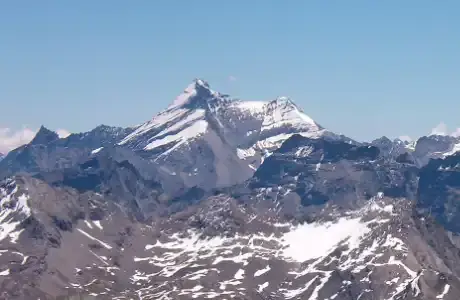
Mont Fallère rises to 3,061 metres on the sunny side of the central valley, above Saint-Pierre, Sarre and Saint-Nicolas. On its northern side open the combes that run down towards the Great St Bernard valley. There is nothing spectacular about its shape. Its strength lies in its position: it stands right in the middle of the Aosta Valley, facing Mont Blanc, Gran Paradiso and the Rutor.
Where does the name come from?
The word “Fallère” is thought to come from patois roots meaning a rocky height or an escarpment. The name would then simply describe the mountain, as is often the case in the Alps. It is one possible explanation among others.
The path of sculptures
The usual starting point is Vetan, a small village in Saint-Pierre, at over 1,700 metres. An easy path crosses meadows, larch woods and summer pastures. It leads to the Mont Fallère hut, at 2,385 metres, in about two hours.
Along the way and around the hut, wooden sculptures await walkers: ibex, marmots, eagles, figures from life on the summer pastures. They were carved from tree trunks by an artist from the valley. With children, spotting them becomes a game all the way up.
The hut itself is recent, built of wood and stone. Its terrace faces Mont Blanc and Gran Paradiso.
Up to the summit
From the hut, a path carries on upwards over grassy and then stony slopes. It passes small lakes, including Lake Fallère, before reaching the final ridge. The summit involves no technical difficulty, but the last section is steep and rocky. Allow about two and a half hours from the hut. It is one of the most accessible 3,000-metre peaks in the valley, provided you have good legs and settled weather.
In winter
When the snow falls, the even slopes of the Fallère attract ski tourers and snowshoers. Avalanche conditions should be checked before setting out, as the upper slopes are exposed.
A balcony in the middle of the valley
From the summit you can see almost all the great mountains of the Aosta Valley. To the south, the glaciers of Gran Paradiso. To the west, the white mass of Mont Blanc. To the north, the Grand Combin. And below, the central valley, with its villages, vineyards and castles, from Saint-Pierre to Aosta.