Monte Rosa
A massif of ice between Gressoney, Ayas and the Valais

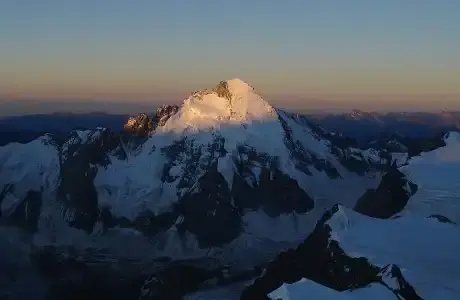
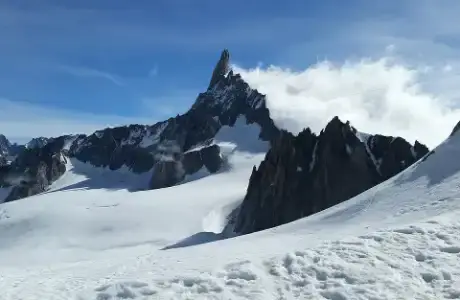
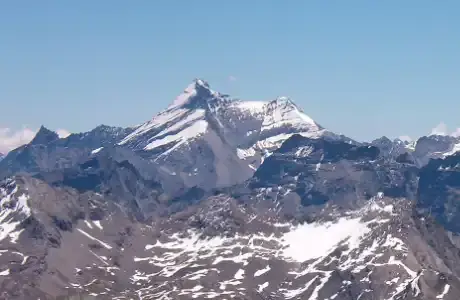
Monte Rosa is not a single mountain but a large, glacier-covered massif. It closes off the Ayas and Gressoney valleys to the north and continues on the Piedmont side towards Alagna and Macugnaga. On the other side, it towers over Zermatt, in Switzerland. It has around ten main summits above 4,000 metres, and many lesser peaks.
A name that has nothing to do with colour
In the evening its glaciers sometimes turn pink, and many people believe that is where the name comes from. In fact it is more likely to derive from an old patois word, close to “rouésa”, which meant glacier. “Monte Rosa” would therefore originally be the “mountain of glaciers”.
The Dufourspitze and the other summits
The highest point, the Dufourspitze (Pointe Dufour), reaches 4,634 metres. It lies on the Swiss side and is named after General Dufour, who directed the first major official map of Switzerland. It is the highest summit in Switzerland and the second highest in the Alps after Mont Blanc.
On the Italian side, the peaks follow one another along the border: the Punta Gnifetti, the Punta Zumstein, the Piramide Vincent, the Lyskamm and then, further west, Castor, Pollux and the Breithorn. Their names tell the story of their exploration. Joseph Zumstein, from Gressoney, climbed the peak that bears his name in 1820. The parish priest of Alagna, Giovanni Gnifetti, reached his in 1842, after several attempts.
The Capanna Margherita, the highest hut in Europe
On the Punta Gnifetti, at 4,554 metres, stands the Capanna Regina Margherita. It is named after Queen Margherita of Italy, who climbed up to it in 1893, the year it opened. It is the highest mountain hut in Europe. It is also a laboratory: since the end of the 19th century, doctors and researchers have studied the effects of altitude on the human body there.
The Walser, the people of Monte Rosa
In the 13th century, peasants from the Upper Valais crossed the passes of Monte Rosa and settled at the heads of the valleys on the Italian side. They are known as the Walser. In Gressoney and Issime, their descendants have kept a language of German origin, titsch or töitschu, and a distinctive architecture: large wooden houses set on stone bases, with granaries raised on piles.
Monterosa Ski
In winter, the Ayas, Gressoney and Alagna valleys are linked by a large ski area, Monterosa Ski. The lifts cross the passes between the valleys, via Champoluc, the Bettaforca pass, Gressoney-La-Trinité and the Salati pass. In summer, the same lifts help climbers get up to the huts and glaciers.
Glaciers that are changing fast
The glaciers of Monte Rosa grow thinner every summer. Some classic routes have changed within a few years: unstable moraines, wider crevasses, more frequent rockfalls. Before setting out, the mountain guides of Gressoney, Ayas and Alagna remain the best source of information on the state of the routes.