The Tête du Rutor
The great glacier above La Thuile

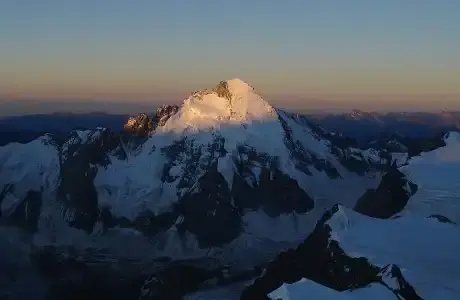
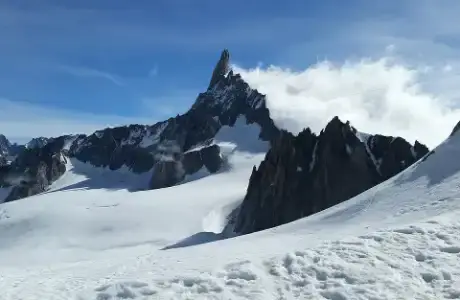
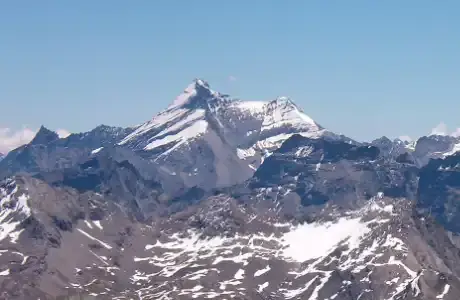
The Tête du Rutor, also spelt Ruitor, rises to 3,486 metres above La Thuile. It belongs to the Graian Alps, on the border between the Aosta Valley and Savoie. Its summit overlooks a vast plateau of ice, the Rutor glacier, one of the largest in the region. On the French side, the slopes run down towards the Tarentaise and Sainte-Foy.
A glacier that caused fear
For a long time the Rutor glacier worried the people of the valley. For centuries, as it advanced, it blocked a side valley and held back a lake. Several times the ice gave way all at once. The lake then emptied into the valley, sweeping away bridges, mills and fields as far as La Thuile and much further down, towards Pré-Saint-Didier and Morgex. The archives record these floods, especially between the 16th and 19th centuries. Today the glacier has retreated a long way and leaves several small lakes behind it.
The Rutor waterfalls
The torrent that flows out of the glacier descends towards La Thuile in three large waterfalls. A path starts from the hamlet of La Joux and follows them one after another through the forest. It is one of the best-known walks in the upper valley. In early summer, when the snow melts, the flow is impressive.
The Deffeyes hut
Above the waterfalls, the path continues towards the plateau of the lakes and the Albert Deffeyes hut, at 2,494 metres. It takes about three hours to get there from La Joux. The hut looks straight across at the glacier. It is a good walking destination in its own right, and the starting point for the Tête du Rutor.
What the glacier leaves behind
As it retreats, the glacier uncovers polished rocks, moraines and new lakes. Scientists follow these changes closely. For walkers, it is a chance to see a landscape that changes almost from one year to the next, between the hut and the ice front.
The summit, on skis or on foot
From the hut, the climb to the summit crosses the glacier. In summer it is done roped up, with crampons and ice axe. There is no difficult section, but the crevasses call for good route-finding and a knowledge of rescue techniques.
In spring the Rutor becomes a great classic of ski touring. The long, even slopes of the glacier lend themselves well to climbing on skins and to the descent. From the summit the view opens onto Mont Blanc to the north and the mountains of the Tarentaise to the west.