The Salassi
The people who held the passes before Rome arrived

Before Rome, the Aosta Valley belonged to the Salassi. This Alpine people, generally linked to the Celts, occupied the region for several centuries. When they settled there is not well known: it is often placed around the 5th century BC, but nothing is certain. The Salassi had a reputation as hardened warriors.
Where does their name come from?
Historians still debate it. One theory connects it with salt. The Salassi may have controlled part of the salt trade across the Alps. Their territory was indeed crossed by ancient routes between the Mediterranean and northern Europe.
Clans and war leaders
Little is known about how they were organised. It is thought that their society was based on clans, bound together by kinship and ties of loyalty, and led by a warrior aristocracy. This model suited life in harsh mountains.
The gold of the Dora
The Salassi were skilled metalworkers. They mined the region’s gold and made jewellery and weapons. According to the Greek geographer Strabo, they diverted river water through channels to wash the gold-bearing sand. These diversions deprived the farmers’ crops further down the valley of water, and led to conflicts.
Facing the legions
Sooner or later, Rome was bound to take an interest in these mountains. It wanted their gold and, above all, control of the passes. Several military campaigns were launched against the Salassi.
Entrenched in their valleys, they held out for a long time. They knew the terrain perfectly and fought bravely. Rome had to commit considerable resources to defeat them. In 25 BC the general Aulus Terentius Varro Murena subdued them. According to Strabo, 36,000 Salassi, including 8,000 men of fighting age, were then sold into slavery.
What remains
After their defeat, the Romans founded Augusta Praetoria, present-day Aosta, and imposed their culture. Yet the Salassi did not vanish without trace. Some place names probably date from their time. Elements of their beliefs probably blended into Roman cults, and later into legends and popular traditions.
Archaeological excavations are helping us learn more about their daily life, their beliefs and their funeral rites. Jewellery, tools and weapons show the skill of their craftsmen.
The huts of Mont Tantané, at La Magdeleine
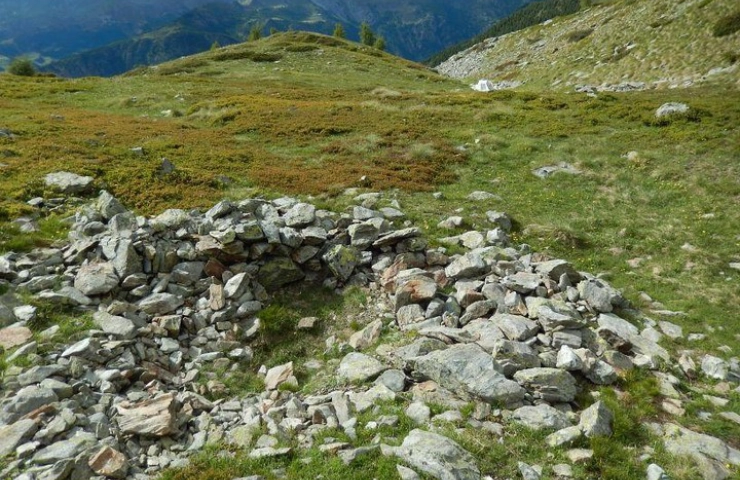
Above La Magdeleine, at more than 2,400 metres, there are 22 dry-stone huts. Local tradition attributes them to the Salassi, hence the name “village of the Salassi”.
The flat stones are carefully fitted together without any mortar. The walls were built with materials found on the spot. They had to withstand cold and wind. This dry-stone technique is still used today in some parts of the Alps.
The village at the Col Pierrey
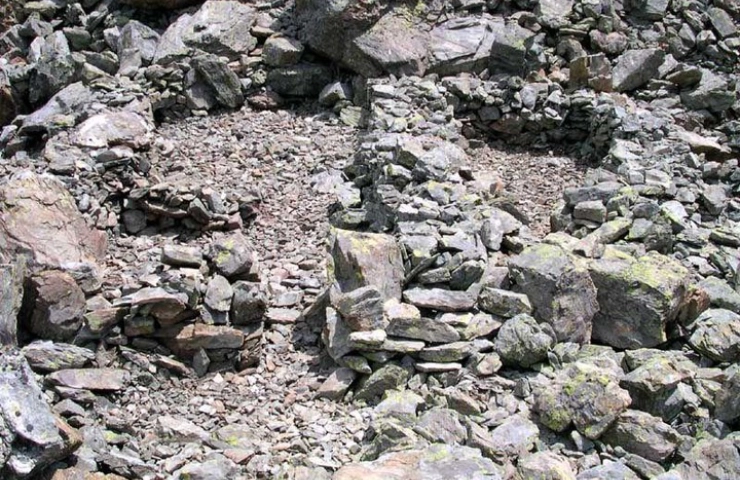
A second group lies near the Col Pierrey, between the Saint-Barthélemy valley and Torgnon. It can only be reached on foot. It has 56 dry-stone huts. Those who built them managed to settle in a very harsh environment.
A Roman coin was found there. This suggests the village may have served as a refuge during the wars.
Many questions remain open. Why live so high up? What did people do there? Archaeologists are still studying the site.
A language without writing
Very little is known about the language of the Salassi. No text has been found: it was passed on orally.
The place names of the Aosta Valley are the best lead for researchers. Several of them go back to roots older than Latin. Words such as “barma” (a rock shelter), “borna” or “djouire” are often cited. They describe the relief and the landscape, and give a small idea of the world in which the Salassi lived.