The Aiguille Noire
The dark tower that guards Val Veny

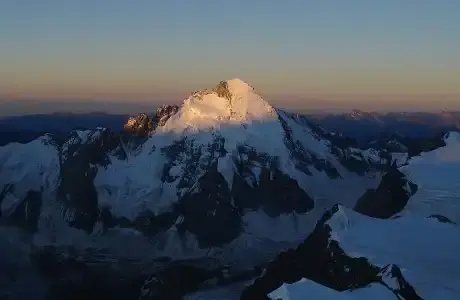
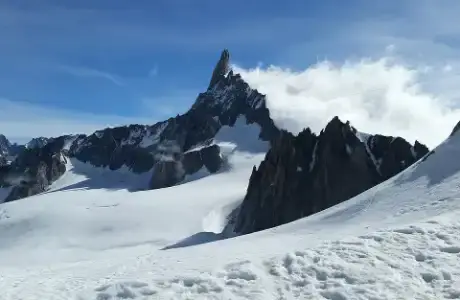
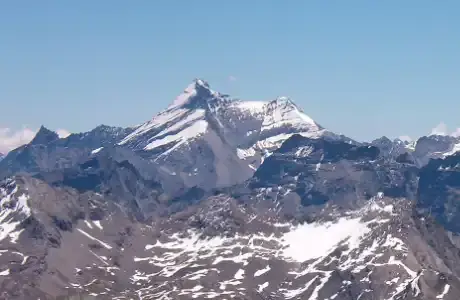
As you enter Val Veny, above Courmayeur, it is all you can see: a tower of dark granite, bristling with spires, rising in a single sweep above the forest. The Aiguille Noire de Peuterey reaches 3,773 metres. It forms the first great step of the Peuterey ridge, which then leads on to the Aiguille Blanche and Mont Blanc.
Why “noire”?
Its name comes from a contrast. Its rock, too steep to hold snow, looks dark all year round. Its neighbour, the Aiguille Blanche, is by contrast covered in snow and ice. Seen together from the valley, the two peaks make a pair that is easy to recognise.
A first ascent in 1877
On 5 August 1877, Lord Wentworth reached the summit with two guides from Courmayeur, Émile Rey and Jean-Baptiste Bich. Their long and complicated route is the origin of today’s normal route, which starts from the Borelli hut above Val Veny and threads its way up a series of gullies and ledges.
The south ridge and its seven points
The south ridge is the mountain’s most famous line. It crosses a series of seven gendarmes, granite towers that each bear a name: several recall climbers and guides, such as Brendel, Welzenbach, Ottoz or Bich. The Germans Karl Brendel and Hermann Schaller climbed it for the first time in 1930.
It is a rock climb of more than a kilometre of height gain, with many abseils on the way down. Many parties do it in two days, with a night’s bivouac at the foot of the ridge. It is only for very fit climbers used to the mountains.
The start of the Peuterey Integral
The south ridge is also the first section of the Peuterey Integral. This route links the Aiguille Noire, the Dames Anglaises, the Aiguille Blanche and Mont Blanc. It generally takes two to three days and several nights in bivouacs, one of them at the small Craveri bivouac hut near the Dames Anglaises. It is one of the longest climbs in the Alps.
A backdrop for walkers
You do not need a rope to enjoy the Aiguille Noire: you can admire it from the floor of Val Veny, in summer as in winter. The path to Lake Miage and the glacier of the same name, and the road up towards Notre-Dame de la Guérison, each offer their own viewpoint. Late in the afternoon the sun lights up its south ridge and the rock turns an almost orange colour.