Via Francigena
From Canterbury to Rome by the Great St Bernard and Aosta

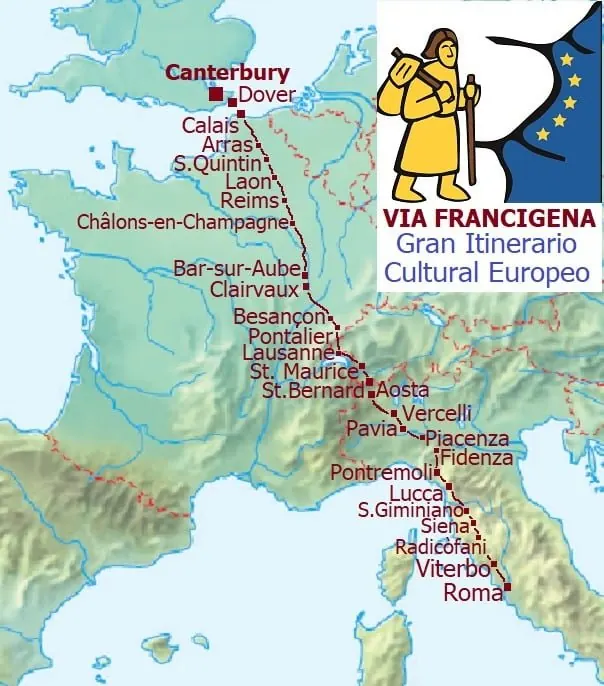
Via Francigena means “the road that comes from France”. This pilgrimage route links Canterbury, in England, with Rome. It crosses France and Switzerland, then the whole of northern and central Italy. In the Aosta Valley it enters by the Great St Bernard Pass and runs down the valley through Aosta.
Archbishop Sigeric, in 990
The Via Francigena is often associated with Sigeric, Archbishop of Canterbury. In 990 he travelled to Rome. On the way back, he noted down the stages of his journey. This list has become the reference for today’s route.
Sigeric’s route is about 2,000 km long. Among other places, it passes through Reims, Besançon, Lausanne, the Great St Bernard, Aosta and Siena before reaching Rome.
A network of paths
Yet the route never had a single line. Depending on the period, travellers took variants, according to the passes, bridges and towns. Most followed old Roman roads. The Great St Bernard crossing and the road to Aosta already existed in Antiquity.
In the Middle Ages the route became a major axis between northern and southern Europe. Pilgrims were not the only ones to use it. Merchants and soldiers followed it too. It encouraged trade between Italy and the markets of the north, and the growth of the towns along the way.
In 1300 Pope Boniface VIII proclaimed the first Holy Year, or Jubilee. Pilgrims then flocked to Rome in very large numbers.
Neglect, then revival
In the modern era the route gradually lost its importance. Interest in it revived at the end of the 20th century. In 1994 the Council of Europe recognised it as a European Cultural Route.
Since then each country has developed its own section. In Italy, a major project aims to develop the route on the model of the Way of St James to Santiago de Compostela. In France it is approved as a long-distance footpath, the GR®145. In Switzerland it is part of the SwitzerlandMobility walking network.
Who looks after it?
The European Association of the Via Francigena Ways (AEVF) coordinates the work at European level. National associations, such as the Fédération française Via Francigena (FFVF), maintain the route and provide information for pilgrims.
Today more and more walkers and cyclists follow the Via Francigena, for a few stages or all the way to Rome. Some set out for religious reasons, others to discover the regions it passes through.